
NAFTA Modernization: A Trilateral Agreement is More Efficient and Friendly for Small Businesses
By SBE Council at 19 September, 2018, 3:09 pm
NEWS
FOR IMMEDIATE RELEASE
Washington, D.C. – Canada’s top trade negotiator is currently in Washington for high-level talks on modernizing the North American Free Trade Agreement (NAFTA). Foreign Minister Chrystia Freeland is meeting with U.S. Trade Representative Robert Lighthizer to hammer out the key areas of contention. The Small Business & Entrepreneurship Council (SBE Council) hopes a deal can be reached, as maintaining this trilateral accord is important to the thousands of small businesses that trade with Canada and Mexico.
“We are hopeful that key issues with Canada will be resolved, as a trilateral agreement is far superior for small businesses in all three countries than bilateral arrangements,” said SBE Council President & CEO Karen Kerrigan.
“NAFTA has created relationships and supply chains across borders and disrupting these would be harmful, especially to small businesses. An agreement that includes Canada and Mexico will create stability and growth for cross-border commerce. This will also reduce regulatory barriers and burdens for small businesses, as navigating one set of rules is more efficient than dealing with two,” added Kerrigan.
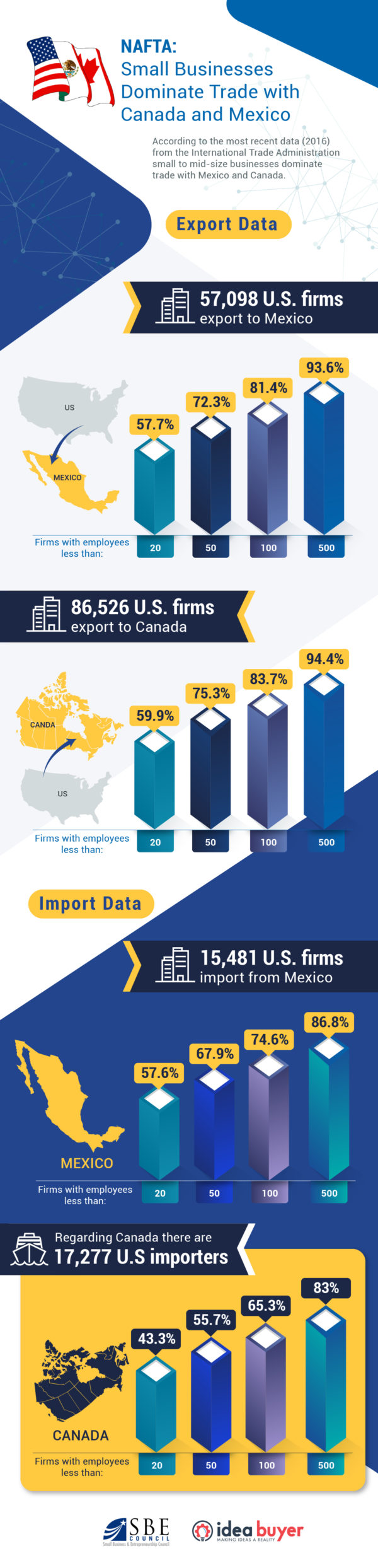
A significant share of U.S. firms that trade with Mexico and Canada are small businesses, as highlighted by the infographic below.
As noted by Kerrigan in a late-August media release regarding President Trump’s announcement that the Administration had reached a preliminary agreement with Mexico on August 27, the provisions outlined in that agreement – such as intellectual property protections and modern rules that govern digital trade – are positives for small businesses. So is the movement away from a hard sunset that ends the agreement after five years, which has been moved to a review process. SBE Council is still interested in the details on content requirements and labor/wage rules, among other provisions.
“Good trade agreements lower barriers and increase trade and opportunity for all parties involved, enable a competitive environment that encourages entrepreneurship and small business growth, and provide certainty through a framework where certain rights – like IP protections – are guaranteed and strengthened,” said Kerrigan.
CONTACT: Karen Kerrigan, kkerrigan@sbecouncil.org
Raymond Keating, Chief Economist, rkeating@sbecouncil.org
SBE Council is a nonpartisan, nonprofit advocacy, research and education organization that works to protect small business and promote entrepreneurship. For nearly 25 years SBE Council has worked to successfully implement a range of policy and private sector initiatives to strengthen the ecosystem for startups and small business growth. To learn more, visit SBE Council’s website: www.sbecouncil.org. Follow on Twitter: @SBECouncil
# # #


Copyright © 2023 Small Business and Entrepreneurship Council. All rights reserved. Any copying, redistribution or retransmission of the contents of this service without the express written consent of SBE Council is expressly prohibited.
Read our Privacy Policy and Terms of Use statements.