
Small Business Owners Rolling into 2024 with Faith in their Business But Heavy Concerns About the Economy: 71% Actively Planning or Taking Steps to Prepare for a Recession
By SBE Council at 20 December, 2023, 12:26 pm
NEWS

President Biden Receives Poor Grades, 93% of Amazon Small Sellers Pleased with Platform’s “Significant Support” and Promotional Initiatives for Small Biz
For Immediate Release
Washington, D.C. – The Small Business Check Up Survey Q4 2024 released by the Small Business & Entrepreneurship Council (SBE Council) reveals how small businesses fared in 2023, which was mixed according to profitability readings for the year. Half (50%) of small business owners say their firms will turn a profit for the year, 25% expect to be in the red, and 25% are still not sure, according to the survey. While most (61%) have a positive outlook for their own business in 2024, 71% hold a bleak view about future economic conditions. Their top concerns have remained consistent over the past three quarterly check-up surveys, with inflation topping the list. Looking ahead, 87% of small business owners say they are concerned that inflationary pressures will persist over the next twelve months.
“Inflation and economic uncertainty make it challenging for business owners to confidently re-invest the limited capital they may have. Moreover, high interest rates and uncertainty are restricting the availability of capital, impacting business competitiveness and growth. The threat of recession is also weighing on business investment decisions – 71% of business owners say they are actively planning or have already taken steps to prepare for a recession. The lack of confidence in future conditions does not bode well for the broader economy,” said SBE Council president & CEO Karen Kerrigan.
Key highlights of the survey relating to small business performance and economic outlook include:
● A majority (55%) of business owners report that revenues have not kept pace with inflation.
● Regarding sales in 2023: 34% report growth, 32% say sales held steady, and 32% report sales have declined. Profitability in 2023 follows a similar pattern: 31% report growth, 30% remained steady, and 39% report a decline in profitability.
● The top five economic concerns for small businesses include: inflation (53%), economic uncertainty (35%), recession/slowdown (30%), rising interest rates (21%) and (TIED) gasoline prices and energy costs (18%) and high taxes or expiring tax provisions favorable to small businesses (18%).
● One-third (32%) plan to increase employment in the next six months, 50% plan to maintain current levels, and 13% plan to downsize.
● Nearly two-thirds rate the availability of credit or capital as fair or poor. Over half of small businesses surveyed (53%) feel the lack of credit is hampering their operating capacity.

SBE Council chief economist Raymond J. Keating observed, “Small business owners are generally positive on the current economic environment, and that’s great. But clearly, entrepreneurs are worried about the economy over the coming year, with a rather astounding 87% concerned about inflation and 81% concerned about a slowdown or recession. Policymakers and elected officials need to take note. They need to focus on a robust pro-growth policy agenda featuring substantive and broad-based tax and regulatory reform and relief, and reining in government spending.”
Basel III Proposal: On one policy proposal in particular – the Federal Reserve’s Basel III Endgame proposal to increase capital requirements for banks – 79% of small business owners expressed concern about the impact on capital availability and access. Over half anticipate reduced capital availability or increased costs, as a result of the policy. Specifically, due to constraints they expect from Basel III, 35% of business owners fear that expansion plans would need to be postponed, 30% expect reduced investments in equipment and technology, and 27% express worry about the survivability of their businesses.
Regarding small business concerns about Basel III, Keating noted: “Small business owners know better than most that increased regulation, no matter who it is said to be targeted at, always ends up hurting small businesses. It’s not surprising, therefore, that the Fed’s proposed Basel III changes raise real concerns among small business owners.”
Technology Platforms, Amazon Small Business Purchasers and Sellers
Following up on previous check-up surveys regarding their use of technology platforms, small business owners currently identified the following top five as the most important for revenue generation and brand building: Facebook (61%), Instagram (40%), Amazon (38%), YouTube (34%) and LinkedIn (25%). Digging further into information generated by previous surveys about Amazon sellers and their use of the platform and sales generation in comparison to other channels, the Q4 survey digs deeper into questions about small business purchasers, small-seller profitability and more.
Small Business Purchasers Highlights:
● Two-thirds (65%) of small business owners reported they purchase products or goods on the Amazon platform.
● Satisfaction with Amazon’s service is high, with 89% giving a rating of 7 or above on a ten-point scale.
● Convenience and the speed/efficiency of delivery are the top reasons for purchasing from Amazon, followed by a wide variety of choices and low/fair prices.
Small Business Seller Highlights
● 22% of small businesses sell their products on Amazon, representing 18% (median) of their total sales. Twenty-five percent reported Amazon sales accounted for 10% or less of total sales; 30% stated that Amazon sales range between 11% to 20% of total sales; 29% reported 21% to 50%; and 16% noted Amazon sales makeup over half of total sales.
● 93% of small seller respondents acknowledge Amazon’s significant support for small business sellers.
● 88% of small sellers agree that Amazon makes small business operations easy and cost-efficient in a competitive economy.
● The median per-product or per-good profit margin on Amazon sales is 16.2%, with 45% reporting higher margins on Amazon than other sales channels. 38% say it is about the same. One-in-six (16%) report lower margins: 11% slightly lower, 5% much lower.
● Per-product profit margins vary widely as 18% of small sellers indicated that their margin exceeds 50%; 32% report 21%-50%; 28% said 11%-20%; and 21% report profits margins of 10% or below.
● 89% agree that they pay a fair price for using Amazon services, which helps them stay competitive.

Regarding the survey’s results on questions pertaining to the small business relationship with Amazon, Keating pointed out, “One of the pillars of the Biden administration’s antitrust attacks on leading U.S. technology businesses is that somehow these platforms are hurting small businesses. The results in this survey serve as an economic reality check on antitrust hyper-regulation from the likes of Federal Trade Commission Chair Lina Khan. Small business owners as purchasers of goods and products and as sellers on the platform are highly satisfied with Amazon. Indeed, it’s important for regulators to keep in mind that a robust market economy involves both competition and cooperation between enterprises.”
Keating added, “For good measure, the survey found that the median per product or per-good profit margin for small business sellers was a notable 16.2%, with 45% reporting higher profit margins on Amazon than other sales channels. That’s unequivocal good news for small businesses. Looking at these survey results, and the simple economic fact that businesses only gain market share under free enterprise by providing value to others, should make clear that the Administration’s antitrust attacks are all about economic ignorance and politics.”
Grading President Biden
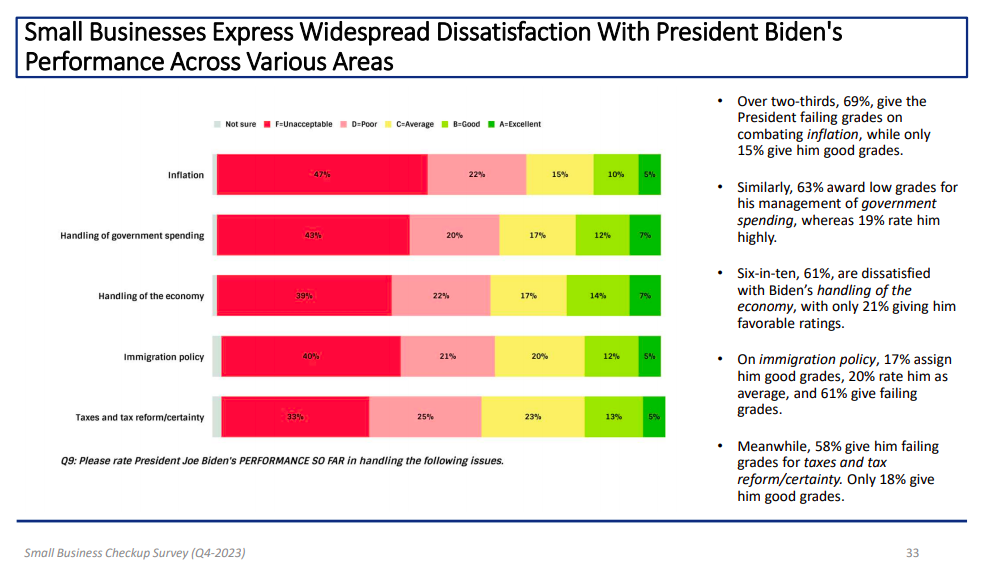
As in previous check-up surveys, President Biden received poor marks from small business owners. Small businesses expressed general dissatisfaction with President Biden’s performance across various areas, and most give President Biden a ‘D’ or ‘F’ on thirteen of fifteen issues covered in the survey.
President Biden and Small Business
● Most small business owners give failing grades for issues such as combating inflation (69%), managing government spending (63%), and handling the economy (61%). Immigration policy also receives failing grades from 61%.
● Similarly, taxes and tax reform garner failing grades from 58%, with only 18% expressing satisfaction.
● A majority (57%) disapprove of his handling of international issues and threats, with a similar 57% assigning failing grades to his approach to U.S. competitiveness with China and other international competitors.
● Half of the respondents express dissatisfaction with his response to the labor shortage, while 21% give him good grades.
● 24% rate his energy policy positively and 53% giving it failing grades.
● Access to capital and credit receives good grades from 19%, but 53% rate him poorly in this area.
Regarding the President’s policies and small business owners, Kerrigan observed:
“President Biden’s policy formula is not working for small business owners and entrepreneurs. Both in practice and in business-owner perception of his effectiveness as a leader. President Biden and his administration need to spend more time talking to small business owners and implementing their common-sense policy solutions rather than advancing the policies of narrow special interests and idealogues.”
CONTACT:
Karen Kerrigan, kkerrigan@sbecouncil.org
Raymond Keating, rkeating@sbecouncil.org
SBE Council is a nonpartisan advocacy, research and education organization dedicated to protecting small business and promoting entrepreneurship. For nearly 30 years, SBE Council has worked on and advanced a range of private sector and public policy initiatives to strengthen the ecosystem for strong startup activity and small business growth.
Visit www.sbecouncil.org for additional information. Twitter: @SBECouncil
###


Copyright © 2023 Small Business and Entrepreneurship Council. All rights reserved. Any copying, redistribution or retransmission of the contents of this service without the express written consent of SBE Council is expressly prohibited.
Read our Privacy Policy and Terms of Use statements.